
"Always Be Turning"
Updated: Jul 23
Form Painting: In Theory
When I began my formal academic study several years ago, I was introduced to a concept known as form painting which is essentially a practice of applying strokes of wet oil paint in a very systematic way that follows the path of light across a form in a progression from light to dark or dark to light like notes moving up or down on a musical scale. As a method, it is a very engaging and satisfying process, as it feels like you are sensitively attuned to the subtle rhythms of your subject with each application of the brush, much in the way a sculptor might feel the resonance of his or her subject in the rapping of surface with a chisel.
The whole concept of form painting is meant to help the artist acquire a tactile sensibility of his or her subject so that the form feels 'real' and convincing to its creator, and therefore real and convincing to the viewer. However, when you work in 2-dimensions on a plane surface, it can take a mental leap to conjure this sculptural appreciation, as we are often held captive by the material identity of our subject.
This mental leap, when successful, plants you firmly on the form of your subject, like a mountaineer plied to his stone, reciting the mantra ‘always be climbing’, or in this case ‘always be turning’; a riff on the popular motivational phrase in sales: ‘always be closing’. The artist-version of this mantra: 'always be turning’ is an instructive guide for the painter who wishes to begin his daunting assent across the various intriguing forms of his subject. This is where the wide-eyed novice begins his journey into the mystical realm that is form painting.
To be a form painter, you are simply painting with a mindset that biases an appreciation of solid form (as it is revealed by light) slightly over surface patterns of shape and color, or what is sometimes referred to as 'notan'. Simply put, form painting is a way of painting that is procedurally unique from other more spontaneous approaches or where layers are applied in semi-transparent washes.
I’ve had teachers in the past assert that you can tell which paintings were derived from a form painting mindset and which from a more optical, flat design mindset. This doesn't mean an artist that is more 'impressionistic' does not consider form. As an artist, you can learn to describe form without a strict, form painting process per se.


(Reference Images Above) Can you distinguish between the painting derived from a form painting bias and that from a more optical approach?
The primary difference between these two works of art might be observed in how much light is used to unify different parts of the picture and how convincing the feeling of form and atmosphere is simulated. Sometimes this difference is both visual as well as sensual and textural, or how 'up close' and connected we feel with the subject, as illustrated in the self portrait by Rembrandt. Contrast the intimacy of the Rembrandt portrait with the Degas cafe painting, where linear shapes and sharp light and shadow underscore the isolation, distance and loneliness of his subject.
Form Painting: In Practice
In practice, I believe the only way to develop a clear concept of form, is to unrelentingly follow the tenet of form painting: 'always be turning'. A form is said to be ‘turning’ when it orients in degrees away or toward the light. We represent those degrees of turning using degrees of lightness or darkness known as value. We can show a surface to be more or less oriented to the light source by adjusting value up or down accordingly on a scale from white to black. There is a ‘timing’ to this process, insofar as the quicker the surface turns up to the light (i.e. the more acute the transition), the more compressed the transitional values become or the greater the contrast we see between a light and dark value. Usually artists refer to this as 'edge control' with softer edges for more slowly turning surfaces and harder edges for more quickly turning sufaces.
Planar surfaces like those of a cube or box, have a relatively 'fast' rate of change between one surface and the next that we interpret visually as a harder edge. For more organic, convex surfaces, like those found on the human body, we see a much more gradual change from light to dark or a slower rate of turn in the surface orientation to the light.

The point however of the “ABT” manta, and why it is so important to keep in your consciousness while painting is that any surface, no matter how slowly or quickly turning away from the light, will always have transitions in value, and they will always be in a graded sequence from light to dark or dark to light. If values stay constant and do not change for a given area, we perceive that area to be flat. However, a flat plane can still have changing values if the light source is sufficiently diminishing or if there is a ‘sheen’ on the surface that might cause light to distribute differently.
Practice and Science
To think of your subject as a graduated series of values is to imagine its surface composed of individual planes that each have a specific orientation to the light.
From a form perspective, a change in value is the result of either a change in surface angle or its distance from a light source. We don't have to know how much light will be scattered or absorbed or in what percentage, just that we will see light crescendo up and down like a dimmer switch depending on how much light reaches a given surface. This means that to show that a particular form has curvature and volume, we need to insert values in a progression that is either moving from light to dark or dark to light.


Where this gets back to a sort of meta-realism and I why I find form painting so creatively fulfilling, is that without this conscious appreciation for the ever changing values that is evoked by the 'always be turning' mantra, it might not even be possible to see these shifts if we resorted to visual appearance alone. When I can think critically about what I am painting as a three-dimensional form--why I see the particular values I see, I can hook-in to the illusion of a three-dimensional visual experience even though I am still mushing pigment around on a flat surface. I consider this to be a hyper-visual experience because I am not solely relying on what I see, but what I know or can ‘feel’ about the surface based on a simple model of light.
The Fallacy of Vision
While I am a self-identifying naturalist, and consummate appealer to the likeness of things (and with it, the lessening of myself and my convictions), if vision was the only consult available for the artist, truly convincing form would ultimately be impossible.
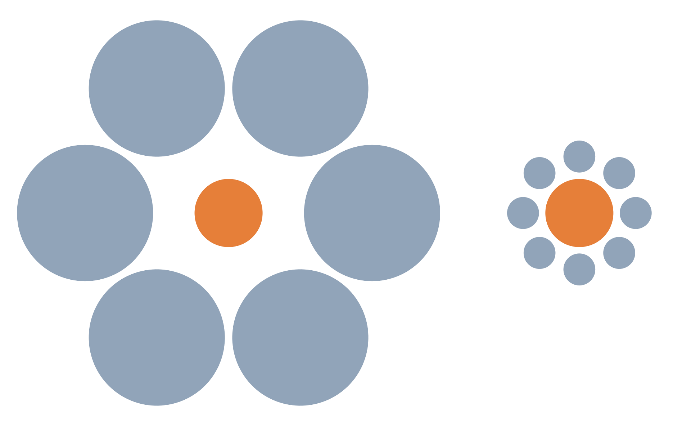
There are many optical illusions readily available online that prove the fallacy of vision and its tendency to make contextual 'errors' in judgment about the size, color and shape of things. The Ebbinghaus illusion is an optical illusion of relative size perception where we perceive the orange circles in each illustration to be different in size when they are in fact, exactly the same size. Much of this illusion has to do with proximity and how we judge size based on its relative position to another element of comparison. The fact that periodically our visual sense may be subject to such distortions suggests that vision alone should not be the only relay of information for the discerning artist.
Conclusion
Why it is important to make a distinction between visual apprehension and a more tactile appreciation of form is that it reminds us that what we see is invariably reinforced by what we ‘know’, and conversely, we cannot truly know something unless we thoughtfully observe it.
'Always be turning’ is not just a mantra about painting a convincing spread of values, but a way to empathically encounter a subject that might be so many feet in front of our eyes and away from us. It encourages a commitment and engagement that faithful copying alone doesn’t achieve. Furthermore, this distinction of form and visual appearance is the critical deciding factor that elevates art into a realm above mere illustration and into the sphere of great story telling. This is not to say art should be intentionally deceptive, but in fact, the humanization or 'feeling' component of its message makes it even more truthful as it is describing an experience that is universally understood, based on a lifetime of intellectual and sensory experience, even if that message is simply the contemplation of something beautiful revealed by light.
Beautifully written and explained. Thank-you.